New driveway installation, complete driveway replacement, and concrete removal for residential and commercial properties across Los Angeles. Built on proper base preparation, accurate grading, and durable construction methods.
A concrete driveway is one of the most heavily used surfaces on a residential property. It handles daily vehicle traffic, weather exposure, and the structural demands of supporting parked vehicles, delivery trucks, and sometimes heavier equipment. When a driveway fails, it is usually because the preparation beneath the surface was inadequate — not because the concrete itself was defective.
In Los Angeles, driveway conditions vary widely depending on the age of the property, the original construction quality, soil conditions, drainage patterns, and tree proximity. Some driveways develop cracking from subgrade settlement. Others deteriorate because drainage was never properly planned, or because the original concrete was too thin for the loads it carries.
Whether you are planning a new concrete driveway installation or evaluating whether your existing driveway needs replacement, the process begins with understanding the specific conditions at your property. As part of our Los Angeles concrete services, we evaluate the site before recommending a scope of work.
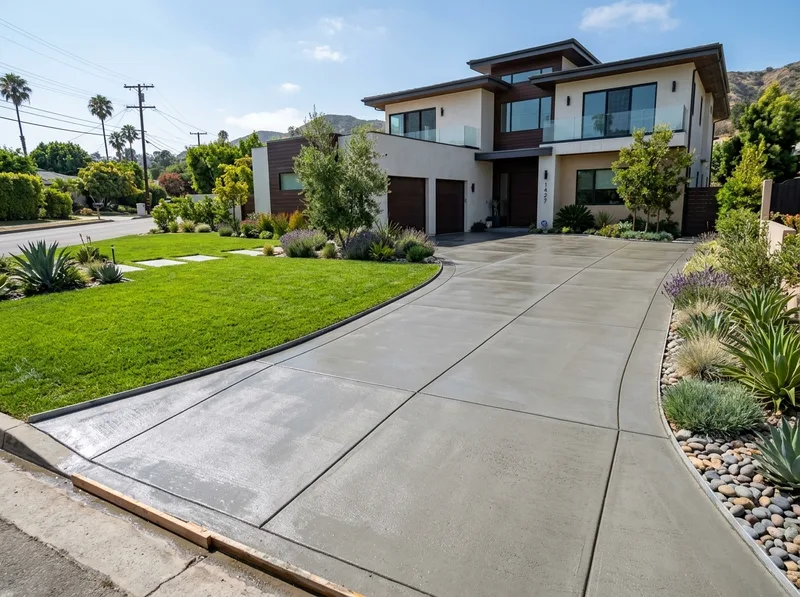
Every driveway project is different. The specific scope depends on existing conditions, property layout, intended use, and access constraints.
The existing driveway condition, soil type, grade, drainage patterns, property access, and any obstacles are assessed before planning the project layout and dimensions.
When replacing an existing driveway, the old concrete is demolished, broken down, and hauled away. Removal includes clearing the work area to prepare for new base material.
The subgrade is graded and compacted. Base material is placed and leveled to provide a stable, load-bearing surface. This step directly influences the long-term performance of the driveway.
Forms are set to define the driveway shape, thickness, and drainage slope. Reinforcement is placed where appropriate based on intended loads and project specifications.
Concrete is placed, consolidated, screeded to grade, and finished. Broom finish is standard for driveways, providing a textured surface with reliable traction for vehicles and foot traffic.
Control joints are cut at planned intervals. The concrete is protected during curing — critical in Los Angeles, where heat and low humidity can cause rapid surface moisture loss.
Los Angeles properties face several conditions that affect driveway concrete over time. Understanding what causes deterioration helps determine whether repair, partial replacement, or full driveway replacement is the appropriate solution.
Each condition requires evaluation to determine whether the issue is isolated or connected to broader subgrade or drainage problems. Surface patching alone does not correct underlying conditions.
Driveway concrete must handle both water and vehicles. Proper slope directs water away from the garage, the home's foundation, and adjacent landscaping. A driveway that pools water after rain creates safety issues, accelerates surface deterioration, and may contribute to subgrade erosion.
Concrete thickness for driveways is determined by the anticipated loads. A residential driveway used by passenger vehicles requires different thickness and reinforcement than a driveway that accommodates larger vehicles, trailers, or heavy delivery trucks. The approach area — where the driveway meets the street — is especially vulnerable to cracking and may require additional reinforcement or thickness depending on grade transitions and traffic patterns.
When planning a concrete driveway installation in Los Angeles, drainage and load considerations are addressed before forms are set. Learn more about concrete slab work or concrete repair options for related project needs.
Each driveway project follows a structured process designed to address site-specific conditions and deliver a surface built for long-term use.
Evaluate the existing driveway, soil conditions, grade, drainage, and access for equipment and material delivery.
Remove existing concrete, grade the subgrade, place and compact base material, and establish proper drainage slope.
Set forms, place reinforcement, pour concrete, consolidate, screed to grade, and apply the selected surface finish.
Cut control joints, protect the surface during curing, remove forms, clean the site, and review completed work.
Curing time depends on the concrete mix, weather conditions, and slab thickness. Light foot traffic is typically possible within a day or two, but vehicle use generally requires a longer curing period. In Los Angeles, high temperatures may accelerate surface drying but do not necessarily mean the concrete has reached adequate strength. Specific timelines are provided with each project.
Driveway cracking can result from subgrade settlement, poor compaction, insufficient control joint spacing, heavy vehicle loads exceeding the slab's capacity, tree root movement beneath the concrete, or inadequate curing. Proper base preparation, appropriate thickness, and planned joint spacing reduce cracking risk.
In many cases, individual sections can be removed and replaced if the surrounding concrete remains in serviceable condition and the underlying cause of damage has been addressed. If deterioration is widespread, or if the base has failed across large areas, full replacement is typically more practical.
The base beneath the concrete supports the entire load of the slab and the vehicles using it. Poorly compacted or unsuitable base material allows the slab to settle, shift, or crack. Proper subgrade grading, adequate base material, and thorough compaction are essential for a driveway that maintains its grade and integrity over time.
Driveways are graded to direct water away from the garage, the home's foundation, and adjacent structures. The slope must be sufficient to move water without creating runoff problems for neighboring properties. Drainage planning is integrated into the form layout before concrete is placed.
Whether you need a new concrete driveway, a driveway replacement, or an evaluation of your existing driveway's condition — contact our team to discuss your project.